Featured

Happy Independence Day – and a Check on Freedom

By Rai Chowdhary

Updated on July 3rd. 2020

freedom under challenge from an enemy you cannot see!

This independence day is like no other. The country (and much of the world) is reeling from the ravages of COVID-19 virus; it continues to threaten our way of life and the economy. The Fed and the leaders of the country are moving full steam ahead to stem the impact on jobs and business. Drug manufacturers are doing all they can to come up with therapeutics and vaccines, but as of now, it is hard to tell when a viable solution will be available. Meanwhile – morale swings from optimism to despair with the news of the day. Independence in these times has a new meaning – “riddance from the menace of COVID-19.”

Times like these pose more challenges for society, and create risk of internal strife. Societal fault lines can open up and lead to its dis-integration, ending up in civil wars or even the division of a country. Whether any country ends up in that predicament remains to be seen. However individual effort can play a big role in “preventing” such an extreme outcome.

individual freedoms and difficult times

If my actions get in your way, there is potential for conflict – especially if we believe we are free to act and do things our way without consideration of the impact on each other. Societies that are more open and free are fertile grounds for this happen. As such, individuals need to be more understanding and tolerant of others. This is hard to do when:

  • people are conditioned to believe that one is above another
  • there are significant inequalities in segments of society
  • systems, norms, and regulations are lax or not enforced adequately, thereby promoting the above,

It must be understood that while a regulation can be legally enforced, it still can allow for inequality to get institutionalized. Then, how are we to avoid this? The answer and the power lies in the hands of the people of the society. However, they have to be enlightened and gain independence from paradigms that imprison them. Here are typical ones:

  • my / our way is the best way
  • I / we vs. them
  • I / we know better
  • if it does not affect me – why should I care

The sooner we realize that we are all connected, and that we are not immune from facing the impact of our own actions, the better off we will be.

Now on to the post from July 2017… see below.

How free* are you – take this Test…

  1. You can choose when to work, where, and have full control over your earnings Y / N
  2. The legal system is accessible, fair, and justice delivered in a reasonable time Y / N
  3. You have freedom of movement – internationally, and domestically Y / N
  4. Freedom of expression and freedom to access information exist  Y / N
  5. You have the freedom to decide who will be your partner  Y / N
  6. You have freedom to practice the religion of your choice  Y / N

* Based on Human Freedom Index dimensions; for an exhaustive analysis, please use link provided
The more Y’s you selected, the higher the levels of freedom you enjoy.

Freedom – Fact, or Fiction

Since pursuit of happiness is common to all living species, and one attempts to find it regardless of their current state, it is common for people of a country / region to think they are free, and be satisfied with their status quo. Particularly if they have nothing else to compare with. All they know is what their government and other officials (including the media) have fed them, directly or through the media.

A research report – Human Freedom Index* provides more insights, and also indicates that economic freedom empowers individuals to exercise other freedoms – a concept I have long advocated. Interestingly enough the 2014 report shows the #1 country when it comes to the HFI is “Hong Kong,” and the world’s most powerful democracy – The USA ranks 23rd., behind Poland! Among the countries that make the bottom 10% of the list are: Libya, Yemen, Iran, Pakistan, and Chad.

So – enjoy Independence Day – but realize that freedom is not “free,” neither can it be taken for granted. For freedom to survive – democracy, responsible citizenry, and sensible choice have to be paramount in how society conducts itself. And, although you are part of society – how far you can go in shaping the future direction of your country (or company – on a smaller scale) will depend on your level of financial independence.
*Source: https://object.cato.org/sites/cato.org/files/human-freedom-index-files/human-freedom-index-2016-update-3.pdf

Featured

About 80% of What You Do – Will Amount to Nothing…

…of consequence. Yes, and I can say that with confidence, it will be lost in the sands of time without a trace. This is almost universally true – the things you do / learn / invest in / try / ….everything!

Strange, right? It has been going on for ages, and yet a vast majority of the populace (including well known national leaders) are oblivious to it – in business, and, personal life.

It started with a discovery by Vilfredo Pareto (1848 – 1923), an engineer, sociologist, and economist. He found that 80% of the land in Italy was held by 20% of the population. Since it has been found to apply almost universally it was named as the Pareto Principle, in his honor.

A lack of understanding and use of this rule results in much wasted time, money, and effort. Pitiably, even today it is not taught in most schools.  In this post, I will provide a few examples from my observations, and share ideas on how to harness the power of the 80/20 principle (aka “the vital few vs. the trivial many“).

Five Examples / Observations from Business Life

  1. 80% of the money managers failed to beat the S&P Small Cap index according to this Huffington post article.
  2. Study your company’s product portfolio – how many products bring in the bulk of the revenue? For several businesses, less than 15% of the products delivered over 90% of the total revenues. You can look at this by region, or customer as well.
  3. Look at your complaints – how many come from a given region or customer? For one computer manufacturer, about 70% of the complaints came from one region. Why? Because the power supply could not handle brown outs that were common to
    that part of the world. You can also study this on a product or part number basis.
  4. Examine your company’s financial statements – which items had the largest dollar amount? Several balance sheets and income statements I have studied showed over 80% of the listed items amounted to less than 10% of the dollar amount. Such analysis can enable focus on the highly leveraged items to improve financial performance.
  5. 68% of IT Projects fail – as is borne out by a study; you can read more about it here; and a second level of analysis can reveal major underlying causes for such failures.

Five Examples / Observations from Personal Life

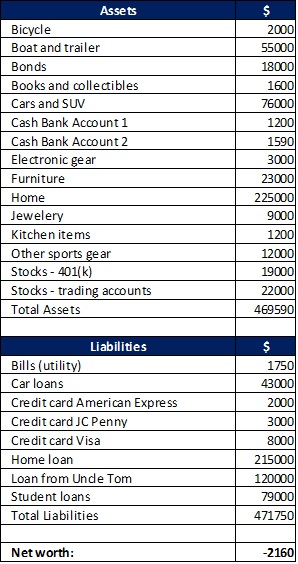
  1. If you have not prepared a statement of net worth for yourself – it is time you did. Examine it to determine which are the vital few vs. the trivial many. See below for one individual’s statement.

NetworthWorksheet

Notice carefully – again – few items add up to much of the total for both – assets, and liabilities.

More importantly, constructing such a statement enables one to see the soundness of their finances. When you examine the top three assets apart from their home, you see that they add up to $150K+, and each of them are losing assets (i.e. the value will only erode over time). And, the net worth is already negative – indicating poor creditworthiness. The situation is likely to get worse with time due to the heavy investment in depreciating assets.

2. Keep a diary for a few weeks, jotting down by 15 minute increments – honestly – what you did. Examine it after a week and add up the total time you spent on things that really matter (wellness, moving forward to your dream, raising responsible and smart kids – if you are a parent, etc.). Divide by the total available time during that period. What do you find? I would love to hear – you can write to me at rai_chowdhary@yahoo.com. All responses will be kept anonymous.

3. What percentage of the things in your purse (or wallet) are used on a daily basis?

4. Look back on your education (if you have already graduated, or if you are still in school – speak with those who have been in the workforce for 5+ years). What percentage of the total learning are you really putting to use? Is it any surprise that a vast majority of the traditional degree programs fall short of preparing you well for the workplace? Neither do they teach you how to manage your finances, and your relationships – both of which are important determinants of wellness and success in life.

5. Study your friends and social circle. What fraction can you really call as true friends? I know many people who would say that number is less than 10%; so 90% of the relationships are just for convenience sake? Now that is sobering isn’t it?

Having said all this, the question is what is one to do? Here are five ideas that will get you started:

  • Focus on what takes up your time; re-align how much time you spend on “in-consequential vs. what really matters”
  • Create a punch list – and use it on a daily basis (see below)
  • Divide your day in 15 minute or 30 minute increments and get the items on the punch list done
  • Create your own systems to reward yourself; you don’t have to wait for others to do this
  • If nothing else works – every time you begin doing something ask yourself “What is the strategic purpose? Why should I spend time on this? Which objective is this linked to?”

So there you have it; a practical approach to making every day count, rather than counting your days!

Thanks for reading, let me know your thoughts, and how did this work for you!

Featured

The Prisoner

Long time ago, my mother told me this story. I have adapted and composed from the original; it is re-produced below. 


Prison Life in Peace

Ken had been in prison for decades with no sign of being released any time soon. Jail wardens came and went, and so did other prison mates. Some passed away, some got released. But, there was no change in Ken’s plight. His court case had become like a ping pong ball between two parties, with no resolution in sight.

Then one day – a young man was brought to his cell. This guy (Jim) has been arrested for assaulting a family member and resisting arrest. We are locking him up in your cell hoping that he can learn somethings from you, the warden said, complimenting Ken for his good behavior over the decades. He thinks because he is the son of a high ranking politician, he is above the law.

Ken welcomed Jim and hugged him with compassion – without asking any question or saying a word. Surprised Jim asked – you don’t even know who I am, and are welcoming me with open arms, how so? Ken simply said – I know who you are, and I can see the real Jim. At the core – we are no different.

Days went by; Ken and Jim grew closer – exchanging ideas and views on a number of topics. Surprised that Ken did not have much remorse, or show any signs of anger, pity, or lament on his condition he asked what was his secret to stay peaceful and smiling. Doesn’t the prison bother you he asked.

The Dawn of Awareness

This prison is nothing compared to the ones we build upon ourselves, Ken replied. Each one of us has made several prisons with multiple walls – some are easily seen, others are so subtle – we don’t even know they exist. Those prisons are more suffocating to me than the one we are living in right now. Jim was utterly confused and his looks reflected that. I will tell you more about this when the time comes.

After a few days, things took a positive turn. Ken was informed that he was to be released next Wednesday; interestingly enough, Jim’s release date was set for the same day as well. On the day of release, the state gave Ken a lump sum of money as living expenses for 3 months and set him free. Not having a family, or any one to turn to, Jim invited Ken to stay with him until he could get on his feet.

On the way to Jim’s place, they passed a pet store that specialized in exotic birds captured in the wild – Rainbow Lorikeets (a type of Parrot),   Macaws, Kingfishers…over a dozen species could be found. Ken bought them all and set them free. Jim could not believe his eyes – how can you do this?

The Rainbow Lorikeet
Enter a caption

Rainbow Lorikeet
Picture source: http://www.oddee.com/item_98487.aspx

Did you like getting out of the prison today? Ken asked. Of course; I am delighted to be free. Now I can get back to work, manage my dad’s office, resume the role of Vice President for his business, drive my Rolls Royce, and live in my mansion. These are things I absolutely relish and can’t be without.

Just like you, these birds are now free from their prison. The only difference is – you have come out from one prison and are about to walk into several more, Ken said. Bewildered – Jim asked – what do you mean by that? How am I walking into more prisons?

Look at the birds flying away; do they know any boundaries? Do they care if they are in your country or the neighboring one? Do they worry about their title? Their possessions? The cage they were in – was the only prison in their life. Now they are free, and living in joy. That is what we are at the core as well. We humans – despite the advanced intellect – create and live in more prisons than we realize. They come in different forms and tie us down: labels and titles we attach to ourselves, possessions we build and crave, roles we adopt, etc. Each becomes a prison, or a wall of a prison, eventually burying our true self.

Ah – Jim said – that is what you said on the first day we met: I know who you are, and at the core we are no different. Now I can see for the first time – how we become enslaved due to attachments, and also realize the fact that everything is transient. So, I guess – the way to deal with all this is to become the seer, one who sees what is going on, rather than get entangled in that which is ephemeral. Now that would be the right use of our intellect, isn’t it?

Exactly!

Adapted from the original, and composed by Rai Chowdhary

Featured

Action, Reaction, and The Poisoned Paratha (Tortilla)

Several decades ago, Leela – a woman from a small town in India lived with her family of five close to the river Godavari. Her husband had a little farm and some livestock that barely sustained the family’s needs. Most of the time they lived hand to mouth, and Leela would make sure no food was thrown away. Any left overs got rolled into the dough Leela used to make her special stuffed triangular tortillas (parathas). Out of her goodness she would always made an extra tortilla – to feed the needy on a daily basis and kept it outside their window just before noon, for whoever might need one.

The truth can be bitter…

Chandu, a crusty old humpback who passed by their house every day noticed this and started helping himself to the tortillas regularly. Rather than be grateful and expressing thanks, he would pass a terse comment as he picked up the tortilla: “Your wrongs will stay with you, and haunt you; while the good deeds will return as positives in your life.” Leela heard this and ignored it remembering Kirit, her son – who had been gone too long. How joyful he would be if he was here, it was his nature to help others she would think.

Months went by and Leela became increasingly irritated with Chandu’s unending tirade. Unable to stand the perceived insults to her ego, she decided to teach him a lesson. She made a tortilla laced with poison, thinking that would be a befitting response to Chandu’s thanklessness. As she went to place it outside the window, inexplicably, she broke out with cold sweat and shivers went up her spine. Realizing her folly – she tossed the poisoned tortilla in the wooden stove and burnt it to ashes. What was I thinking, what was I doing – she muttered to herself. Repenting, she made another one in its place, while still plotting to get even somehow.

The sweetness is latent – behind the bitter words…

Chandu came by, picked it up as usual, and moved on; Leela continued with her chores and tending to her family’s livestock. Something just did not just feel right though, and occasional shivers lingered on. It was late afternoon, and the day seemed to drag. To calm herself down she went back in the kitchen to make her favorite Darjeeling tea. Just as she was getting started – there was knocking at the door. Mom, it’s me, Kirit.

Leela could not believe her ears. Kirit! “My son is back” – she ran and hugged him, tears of joy rolled down her cheeks. He was disheveled, and his clothes were torn, but that didn’t matter, he was back, alive, and well. After he freshened up, the two started to prepare supper; Leela was looking forward to re-living the experience of having the “whole” family at the dinner table again. As she made tortillas – Kirit narrated his experiences. He told her of his travels and tribulations over the last several months; places he had been to, and the storms he had survived. Godavari can be a challenging river especially when you are rowing a flat bottom boat, he explained. Finally he came to the episode that had unfolded moments ago.

Having gone without food for days, and being out on the river in the blazing sun, I was dead tired, he said. Reaching ashore, I moored the boat and made my way up the hill. Unable to walk anymore, out of hunger, thirst, and exhaustion I collapsed about a mile from our house. Luckily – a crusty old and frail humpback, who looked like a beggar, seeing me on the ground came to my rescue. It was he who helped me regain consciousness. He was so nice – not only did he bring me some water, but he also fed me the only tortilla he had. It looked exactly like the triangular one you are making now. I asked him from where he got it, and why he didn’t eat it.

There is this noble woman, about a mile from here he said. She makes one for me every day; today you need it more than me. I can go hungry for now. Looks like you haven’t eaten for days, so here, take it.

The awakening…

Leela was stunned, speechless, trembling, and sinking as Kirit finished his story. He held her tight asking what had happened. What was wrong? After a while Leela responded – “I am just so thankful to god you are alive; things could have taken a very bad turn today. A wise man has been telling me that our wrongs will stay with us and haunt us, while the good deeds come back as positives in our life.” Touched by these poignant lines, Kirit asked “What wrong did you do? And, how can I meet this wise man?” Leela said “he will be back tomorrow afternoon, you can meet him then. What I have just realized is things are not what they appear to be, our egos hijack our lives and run on auto-pilot for the most part. We need to learn how to control our responses (reactions) to stimuli (actions of others and triggers) rather than try to control the latter.”

The next day Kirit saw the whole series of events first hand. Chandu recognized him as he passed by the window; Kirit stepped out to greet and thank him for saving his life – offering him money in return for his help from yesterday. Chandu just smiled and said – if you reciprocate what I did for you with someone else, just one good deed a day – that would be reward enough for me; remember, he continued – your reaction to the actions you encounter in the world are an indicator of your true core, strength, and character. Hearing this, Leela came out with folded hands, and humbly said “we are blessed to have you come by every afternoon, and it is an honor to serve you.”  Chandu said so be it, and moved on. Leela and Kirit watched as he disappeared over the horizon. His parting words were “what we eat today, will eat us one day.” Both wondered – what does that mean, and, if they would have to wait for another episode to unravel that?

Rai Chowdhary

This is another story sent to me by my sister – the original was in Hindi; I have translated it and made some additions to the contextual settings for better impact. Let me know your thoughts.  

Featured

Lessons in “Identity” from a bunch of Grapes!

Let me start with the story my sister sent me yesterday. A shopkeeper was selling grapes – some were in bunches, others were loose and were being offered at half the price. A woman became curious about the price difference and asked him what was wrong with the ones being sold loose?

Nothing – replied the shopkeeper. The type and quality of both grapes is identical as you can see; the loose grapes are not part of the bunch, and therefore have no identity anymore; as a result they have lost their worth.

This was stunning; how and why could identity matter so much? Is being “attached” or “belonging to some group” so important? Is there a lesson here that we need to learn? The topic of what really constitutes our identity is rather deep and complex – with several books being written on the subject. I will touch on just a few aspects – and invite you to share your thoughts.

Identity – What is it and why is it necessary anyway?

Let us take a closer look at “identity” in a couple of ways…

We identify ourselves using various descriptors – which include professions, places, communities/families, symbols of wealth, religions, etc. Thus it is common for us to say I am an American, an engineer, and I come from the royal family…etc. It seems to create a sense of certainty, belonging, power, ego, helping project to the world (and ourselves) – “who” we are, and by extension what we stand for. Is this somewhat akin to grapes being attached to a bunch?

The Social Angle

One perspective (social) is provided by Maslow’s hierarchy of human needs. It posits that we look to fulfill our needs for love/belonging, and self-esteem arise after our basic needs of survival (food, shelter, and security) are met. Thus – our “identification” with groups, places, etc. are higher up in the scale.

Body and Mind

Another angle is to think in terms of the physical body and the mind – I am this person; these are my hands, legs, feet, my eyes, my ears, my mind, my thoughts, etc. This surfaces an interesting question – if these are “my” limbs, and, sense organs etc., then where is that “I” – the owner of these things? Inside my body? Has anyone seen that “I”? Is it tangible, or just a concept, or is there something beyond that? I am Rai and this is my body; 20 years ago, I was Rai too, however, I did NOT have the same body; we know that body has re-cycled itself many times over during that span of time, and my thinking, understanding, perception, all have undergone changes as well. So – who am I today?

Relative or Absolute?

Some folks maintain there is the relative identity and the absolute identity. Our little self that appears to be visible here and takes itself so seriously is merely a relative identity (whether good or bad); it is not our absolute identity that we are eternally in God. The Buddhist idea of letting go of our attachment to our relative identity is almost identical to Jesus’ teaching of dying to our self (or even “renouncing the self” as in Mark 8:34).
(Source: https://abqecc.wordpress.com/2013/08/22/relative-and-absolute-identity/)

Worth – From who’s Perspective?

Attempting to bring the above discussion to a close cannot happen without looking into the crucial question of who determines the worth, and the basis for that determination. Even more fundamentally one needs to ask – Is the determination of worth important?

My view is that unless you are engaged in a transaction (financial, social, or other) of sorts – the determination of worth is not important. Life is what it is, and will become what we make of it within the framework of the karmic principles.

Where the determination of worth makes sense – it behooves us to ask the question do I want to be measured by my own yardstick, or someone else’s – and who that someone else should be. Further, how do I know that any yardstick will be consistent over time – knowing that we humans are susceptible to fickleness, and change over time.

As for the grapes – they did lose their connection with the bunch – but not their true identity. What do you think? I would love to hear…

Featured

The gazing fakir (monk)

This story was sent to me by my sister, the original was in Hindi, I have rendered it in English with minor touch ups.

Procrastination or anticipation

Long time ago a fakir would sit by the bank of a river and gaze endlessly at the water rushing by. No one knew why he did this; was he meditating, contemplating, or something else.

One day a curious passerby asked him what he was doing at the bank gazing emptily. Expecting for someone to show up? The fakir replied “I want to cross the river, but I am getting delayed.” Why so, what is holding you back, asked the passerby. “I come here every day in the hope that the river will have completely flown all the water it has, so I can cross it. Hasn’t worked so far, and I don’t know when that day will come.”

More delays…and a Solution!

The passerby was amused and commented if you keep waiting for the flow of water to run out, you will never be able to cross the river. The fakir replied “That is exactly the message I am trying to deliver – you all are getting delayed, and might not be able to reach the other bank either.”

Did I miss something? We are getting delayed for what – asked the passerby, confused at the fakir’s remark. “The delay I am referring to is about doing the three essentials on your journey through this life. They are: ‘seva’ (being in service with devotion and compassion*), ‘simran’ (reflect on who we really are*, and remembrance of the lord in all you do), and ‘satsang’ (gathering to share wisdom and guidance*). Waiting (like me) – until all your worldly engagements and responsibilities are exhausted will mean you will be waiting forever, and your time on the planet will run out” commented the fakir.

Having delivered his message – the fakir got up and moved forward to the river with determination. His closed with these final comments “The work and responsibilities of our life will be unending. We need to create the path forward performing ‘sat’, ‘seva’, and ‘simran’ as part of the journey.”


*http://www.huffingtonpost.com/deepak-chopra/new-humanity-part-2_b_19720.html

On Karma, Luck, and more…

This story was sent to me by my sister; I don’t know who wrote it, however, it has very important messages – so I am sharing it here, together with my thoughts.

The Sweet Paanwala

There was a paanwala in India who was known for his friendly and welcoming nature. His ability to converse on diverse topics was legendary, to the extent that often customers would excuse themselves from the dialog in the interest of time. One day the dialog turned to Karma (deeds) and Luck (bhagya).

The topic being of interest to me, I felt like pursuing the talk further and gaining insight into his philosophy on the subject. So I lobbed a question at him “Does a person progress more from his / her effort (Karama) or due to their luck?”

In his usual pleasing manner, he asked if I had a safe deposit bank locker? Since I had one, my response was in the affirmative. He continued “Every locker has 2 keys, you have one, the other is with the banker. The one you hold is the key of Karma; the one with the banker is that of Luck. Unless both keys are applied, the locker cannot be opened.”

“You need to continue doing your part (Karmas – applying the key to the locker). You never know when the almighty will apply his key, and if at that moment – you are absent, the opportunity to open the locker’s contents will be lost.”

Metaphors and Their Limits

The story above is a great metaphor and provides a simple yet powerful explanation on Karma and Luck. It also seems to suggest that your efforts might go in vain when the banker does not apply his / her key.  We need to understand that a metaphor is a “representation” and not the original truth or message. Thus – every metaphor has its limits.

My view is that our efforts are never in vain – how and when the results will manifest depends on many factors.  When your efforts are aligned with natural forces, the results come easier and in abundance.

I view our efforts as seeds we sow – also there are necessary conditions that have to be met for seeds to sprout and produce fruit. Another factor is the type of seed. You can reap the harvest from a coriander seed in a matter of months, however a mango tree will take years to bear fruit. A bamboo tree will take decades.

Having said all this – we need to bear in mind there is no assurance that “every” seed will deliver (every Karma will produce results). On the flip side, one thing is for sure – the chances of getting results with no effort are just about zero!

Cause and Effect – An Endless Cycle

Vedanta tells us the Karma principle (cause and effect) prevails and works over many lifetimes. Seeking tangible evidence to prove or validate this – in my view – is futile since we depend on our sensory system for detecting and making sense from evidence. Human detection systems have serious limitations and are therefore suspect (for example – they cannot detect X-rays at all, neither can we touch / feel everything we see…who has touched a rainbow?).

There is some emerging research on the topic of multiple lifetimes of existence, I am studying it as of now. Will share it over the next several months. 


Go back

Your message has been sent

Warning
Warning
Warning
Warning
Warning

Warning.

Defeating Gout

By Rai Chowdhary

First published July 16th. 2012, last updated April 9th. 2020

Wow! Almost 8 years have gone by since I visited this page. Love to report that my gout is better than ever – very few attacks and far in between. Even if there is an attack, it is rather mild – feels so good to be completely medication free.  So what is my secret?

Regimen of daily exercise and diet control continues. Over the years I have more or less switched to a vegetarian diet – and a smoothie with berries just about every day.

Potentially another discovery

Along the way I also noticed that the elastic band in my socks would leave its mark as a small depression around the lower leg; to me, this was indicative of potentially reduced circulation to the ankle and toes.  Why do I believe this could be a contributory factor?

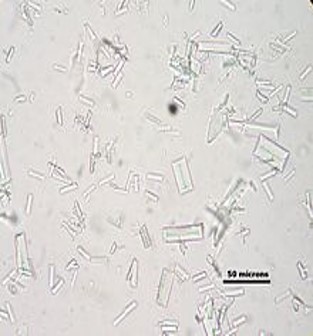
Well – gout essentially occurs due to crystallization of uric acid that form in the joints. Crystallization can easily occur when fluid flow is minimal to none. As such – the combination of exercise and socks with loose bands might promote better circulation to the lower extremities, thereby reducing the chances of crystal formation.

uric acid crystals

Proving this will require a controlled experiment – which I might do at some point; and if that happens – I will post an update again.

Meanwhile – if you would like to discuss further or exchange ideas – feel free to connect with me on LinkedIn and drop me a note.

Thanks for reading – and wishing you a gout free life!


Original post from July 16 2012

Background

I have had several attacks of gout over the last few decades, however about 5 to 6 years ago, I embarked on a regimen of diet, exercise, and careful monitoring of the symptoms. Once the symptoms started showing up, I have aggressively gone after certain steps that have kept me away from medications and helped manage the attacks with minimal effort. I will share these below, and trust you will get some benefit from the same.

Symptoms

In my case the gout attack used to begin with pain in the ankle, and it used to be excruciating. Initially, not knowing what it was, I used to try and suppress the pain by using over the counter pain killers. It was of little help. My doctor put me on Indomethicin, however it would make me dizzy during the day. This continued for a while, then a few years later, the symptoms would manifest as pain in the big toe.  Gradually, I learned through trial and error what foods were trigger causes, and what steps I could take to reduce the severity of the attack. Eventually I came to recognize the symptoms of an impending attack, and how to aggressively counter the same.

Steps I now take at the first evidence of symptoms

As soon as I sense the onset of a gout attack (pain in the big toe or ankle with a slight feeling of swelling / tightness) double my intake of water, coupled with a high intake of berries or berry juices. This is accompanied by an immediate diet change where I go on  a low protein foods.